
When you secure a mortgage through the Federal Housing Administration (FHA), you’re not just taking on a loan—you’re investing in protection for one of the most important assets you’ll ever own: Your home. FHA hazard insurance, a form of home insurance, ensures that both you and the lender are safeguarded against unexpected disasters like fire, wind, vandalism, and more. With this coverage in place, you can rest easy knowing that the structure of your home is backed by a policy tailored to FHA requirements.
Beyond providing peace of mind, FHA hazard insurance serves as a foundational layer in the mortgage process. It contributes to the overall financial security of your investment, potentially improving loan terms and reducing lender risk. As you read this article, you’ll gain a clear grasp of FHA hazard insurance’s what, why, and how—empowering you to make an informed choice that enhances both protection and financial strategy
Why FHA Requires Hazard Insurance — Smart Protection Guide
FHA hazard insurance isn’t optional—it’s mandatory. The FHA requires borrowers to carry hazard insurance to protect against structural loss from covered events. This mandate is rooted in safeguarding the lender’s investment, but it’s also crucial for homeowner security. Here’s a deeper dive:
- Protecting the Lender’s Collateral
The home serves as collateral for the loan. Without hazard insurance, unforeseen damage (such as from a fire, windstorm, or vandalism) could reduce the home’s value. The FHA requires insurance to preserve that value and mitigate financial loss. - Ensuring Homeowner Security
Hazard insurance extends far beyond lender interests. It ensures the homeowner can recover from disasters without being left in financial ruin. For those with limited savings or emergency funds, this coverage is essential to avoid overwhelming costs. - Regulatory Compliance
FHA insurance guidelines are set at a national level. Borrowers must follow these government-backed standards, which ensure uniform protection across all FHA-backed properties regardless of location. - Loan Eligibility and Closing Requirements
FHA guidelines mandate proof of hazard insurance before closing. A binder or declaration page must be submitted by the closing date, verifying that the required coverage is in place. Failing this, the mortgage will not finalize, potentially delaying your move-in date and adding stress.
Understanding FHA Hazard Insurance — Clear Benefits Explained
FHA hazard insurance offers several direct perks that enhance both borrower experience and lender assurance:
- Minimal Coverage Standards for Safety
FHA sets a minimum coverage level—usually the lower of the home’s replacement cost or loan balance—so borrowers aren’t underinsured. This standard ensures structural rebuilding won’t fall short if disaster strikes. - Structural-First Focus
The FHA emphasizes coverage for the home structure itself—walls, roof, foundation—delivering protection even when personal belongings aren’t included in the basic policy. - Potential for Easier Loan Approval
Carrying the right insurance package bolsters your loan file. Borrowers who come prepared with binder, deductible, and insurer proof streamline approval and close faster. - Long-Term Financial Stability
Once the policy is paid, coverage spans the full loan term—ensuring protection throughout your mortgage payoff journey. This minimizes risk and helps avoid minimum coverage rescinds due to loan balance fluctuation.
Is Hazard Insurance Mandatory for FHA? Helpful Insights
Yes—hazard insurance is non-negotiable for FHA borrowers. Lenders won’t close a loan without proof of a valid policy, and HUD/FHA regulations are clear: the coverage must:
- Be in place at loan closing
- Name both borrower and lender as insured parties
- Meet minimum coverage that satisfies FHA standards
- Be underwritten by licensed, reliable insurance companies
Even after closing, remaining compliant is essential. FHA requires continuous coverage during the loan term. Cancelling it—even unintentionally—triggers serious lender action, including force-placed insurance, higher premiums, or even foreclosure.
What Does FHA Hazard Insurance Actually Cover?
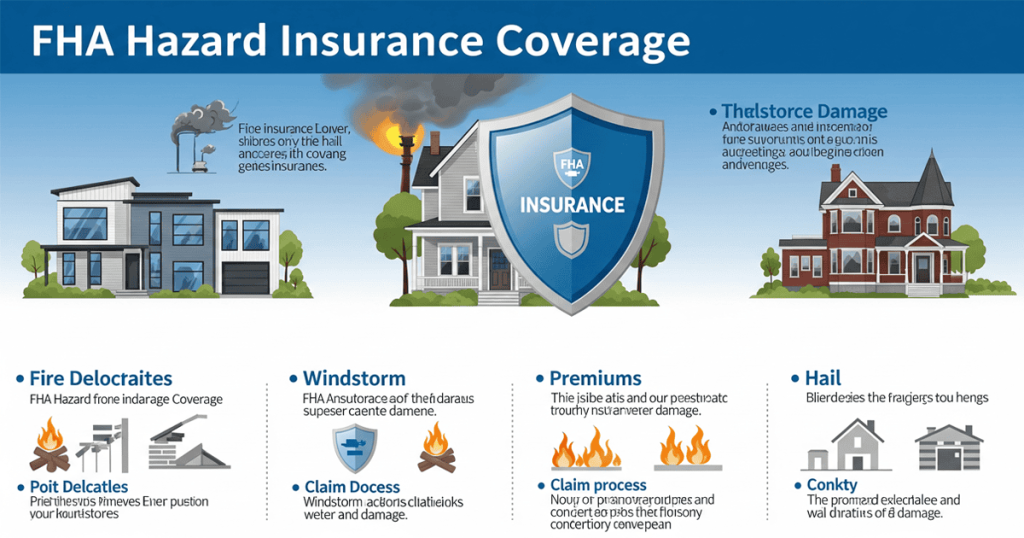
This covers the structure of your home from specific hazards. Here’s what a standard FHA policy typically includes:
- Residential structure – Walls, roof, foundation, floors, windows.
- Detached structures – Sheds, garages, and gazebos (typically up to 10% of dwelling coverage).
- Fire and lightning – Damage from fire/sparks.
- Wind or hail – Storm-related devastation.
- Smoke damage – From short-term exposure.
- Explosions – Unexpected blasts or ruptures.
- Vandalism or malicious mischief – Coverage for intentional damage.
- Theft – Related structural break-ins or forced entry.
What isn’t covered?
- Earthquake, flood, mold, windstorm in hurricane regions (unless endorsed separately).
- Home contents unless added by the homeowner.
- Normal wear and tear, pests, or long-term neglect.
How FHA Determines Coverage Amount: Key Factors
FHA determines coverage using two broad metrics:
- Home’s Replacement Cost
The insurance must cover the estimated cost to rebuild your home at current materials and labor rates. - Current Loan Balance
FHA requires coverage of at least the unpaid mortgage amount—ensuring enough insurance exists to protect both parties.
Solving for the right coverage:
- FHA insists on choosing the smaller of replacement cost or loan balance. A lender may also require replacement-cost endorsement.
- Home apps or contractor quotes typically estimate replacement cost.
- Insurance companies often provide local rebuild cost calculators.
Avoiding FHA Pitfalls — Common Coverage Mistakes
Steering clear of mistakes safeguards your home and financial future:
- Setting inadequate coverage limits
Coverage that doesn’t meet FHA’s minimum places you in violation of loan terms—and increases lender risk. - Wrong or excessive deductible
FHA caps dwelling deductibles at 1% (e.g., $1,200 on a $120,000 home) and 2% for wind/hurricane in coastal zones. Higher deductibles can lower premiums but risk bigger out-of-pocket claims. - Not addressing FHA add-ons
Hazard insurance doesn’t include flood or earthquake. If your home is in a risk zone, separate policies are required. - Letting the policy lapse
A period without coverage may allow your lender to “force-place” a policy—typically costlier and limited in coverage. - Choosing disqualified insurers
Insurers must be licensed in your state and have acceptable financial stability ratings (AM Best “A–” or higher, Demotech “A” or better). FHA won’t accept carriers that don’t meet these standards.
Perils Included & Excluded: FHA Standard Policy Explained
✅ Included “Named Perils”
- Fire, lightning, smoke
- Wind, hail
- Explosion
- Riot, civil commotion
- Damage from aircraft or vehicles
- Vandalism/malicious mischief
- Theft and structural damage due to break-in
❌ Excluded Perils
- Flooding (unless added)
- Earthquake
- General wear/tear or pest damage
- Additional catastrophes, like sinkholes, volcanic ash
These exclusions are typical, but you must explicitly review your policy for gaps—understanding them is vital for full FHA compliance and personal protection.
Replacement Cost vs. Mortgage Balance — FHA Rules
Replacement cost estimates what it would cost to rebuild your home today. Mortgage balance is the outstanding amount you owe. FHA rules require coverage to satisfy both:
- If replacement cost < loan balance:
Borrower can insure for replacement cost. - If loan balance < replacement cost:
Coverage must equal loan balance at minimum.
FHA endorsements:
Lenders can require additional built-in endorsements, like “Replacement Cost Plus,” which automatically adjusts coverage annually to protect against inflation.
Flood, Wind & Earthquake Insurance: FHA Add‑on Requirements
For properties in hazard zones, standard FHA hazard insurance is only half the picture. Here’s what FHA requires:
- Flood Insurance:
Homes in special flood hazard zones must carry NFIP flood insurance. - Windstorm Insurance:
Coastal properties in high-wind areas may need standalone wind policies. - Earthquake Insurance:
Required if your home is located in quake-prone zones (e.g., parts of California, Pacific Northwest).
These policies must be current and listed in escrow. Without them, FHA won’t close, and lenders may refuse coverage or set stricter terms.
Selecting an Approved Insurer for FHA Hazard Policy
When choosing an insurer, keep in mind:
- Licensing & Ratings:
Only work with insurers licensed in your state with strong financials (AM Best “A–”+, Demotech “A”+). FHA won’t accept carriers outside these guidelines. - Replacement Cost Calculator:
Use carriers that offer rebuild cost estimations tied to local conditions—ensuring coverage keeps pace with market rates. - Customer Support & Claims Handling:
Check reviews and complaint ratings (e.g., state insurance department or NAIC). Prompt claim service is non-negotiable after a disaster. - Policy Add-ons:
Ask if the insurer can combine flood, wind, or earthquake coverages for bundled convenience.
Tips to Lower Premiums Without Breaking Coverage Rules
Smart ways to reduce FHA insurance premiums include:
- Choose a Moderate Deductible
Keep the deductible at or slightly below FHA caps—1%, or 2% in wind zones—so savings don’t cost more if you file a claim. - Bundle with Flood or Other Hazard Policies
Combined policies often come with multi-policy discounts. - Improve Home Safety Features
Adding smoke alarms, deadbolt locks, or a security system can qualify for insurer discounts. - Reduce Construction Risk
Avoid cheap roofing materials or outdated wiring, which hike premiums. Re-inspect prior to renewal. - Temporal Shopping
Get quotes annually. Insurance pricing can shift quickly based on regional trends or individual records—renew with a lower premium if available.
When & How to Update Your FHA Hazard Insurance
Updating your policy ensures it stays relevant and compliant:
- Annual Renewal Period:
Review your plan every year. Adjust coverage based on changes like home value increases, renovations, or new insurance products. - Home Improvements or Extensions:
Build a result: cover the added dwelling value. Trigger insurer notification at policy renewal. - Post-Claim Review:
After filing a claim, verify your insurer rebuilt to full value. If not, request adjustments or replacement-cost endorsement. - Refinancing or Escalating Loan Balances:
Coverage amounts must track with your updated mortgage balance. Increase coverage accordingly.
Maintaining Hazard Coverage During FHA’s Loan Term
Once your FHA loan is in place, coverage must remain active until the loan is fully paid:
- Lapse Consequences:
Skipping premium payments can result in lender-enforced force-placed insurance—often more expensive and limited. - Escrow Compliance:
Most FHA loans require your insurer’s premium to be escrowed. Lender holds the money and pays annually to maintain seamless coverage. - Annual Review:
Lenders verify insurance status yearly. You must submit a renewal declaration, or they may force-place.
Escrow Accounts & FHA Hazard Insurance Payments
FHA loans typically include escrow accounts for taxes and insurance:
- Monthly Escrow Contributions:
Your lender collects a portion of annual hazard insurance premiums each month, along with property taxes. - Annual Disbursement:
At renewal, lender pays the insurer directly from escrow—protecting you from missed payments. - Shortage/Surplus Adjustments:
If premiums rise, the monthly escrow payment increases—so prepare for potential cost upticks.
What Happens If You Cancel FHA Hazard Coverage?
Cancelling your insurance is serious:
- Lender Warning or Default Notice:
Your loan servicer will notify you. Continued lack makes you in default. - Force-Placed Insurance Option:
The lender buys hazard coverage on your behalf—usually double the cost and limited in personal property protection. - Escalating Costs:
Force-placed premiums may accrue in your escrow account, increasing monthly payments or until due. - Legal Consequences or Foreclosure:
Extended livelihood of coverage violations can lead to foreclosure—your home’s most severe risk.
Frequently Asked Questions
Is hazard insurance required before FHA loan closing?
Yes—proof must be submitted prior to closing. FHA lenders won’t finalize loans without an official binder or declaration page documenting valid coverage.
How much coverage does FHA hazard insurance require?
At minimum, coverage must match either the home’s replacement cost or mortgage balance—whichever is lower. Some lenders also require a replacement cost endorsement to cover rebuilding needs.
Are add-on policies like flood or windstorm included?
No—standard FHA hazard insurance does not include them. If your home lies in flood, wind, or quake zones, separate or endorsed policies are mandatory.
What deductible limits apply under FHA guidelines?
The dwelling deductible must not exceed 1% of coverage, except in specific high-risk wind/hurricane zones where 2% deductibles may apply. Your policy must strictly comply.
Can borrowers choose any insurer they like?
Yes, but only insurers licensed in the property’s state and with financially strong ratings (AM Best “A–”+ or Demotech “A”+) are acceptable under FHA rules.
Final Thoughts
FHA hazard insurance is a safeguard—protecting both your home and your loan. From choosing the right policy, understanding coverage rules, addressing peril-specific add-ons, to avoiding common pitfalls—it’s about managing risk wisely and staying compliant with FHA lending standards. By actively monitoring your insurance, selecting reputable providers, and making strategic decisions, you ensure ongoing financial protection and peace of mind throughout your FHA loan journey.
This guide has offered clear, in-depth insights—aimed at helping homeowners like you make informed decisions, optimize loan performance, and enjoy confident, long-term coverage under FHA hazard rules.